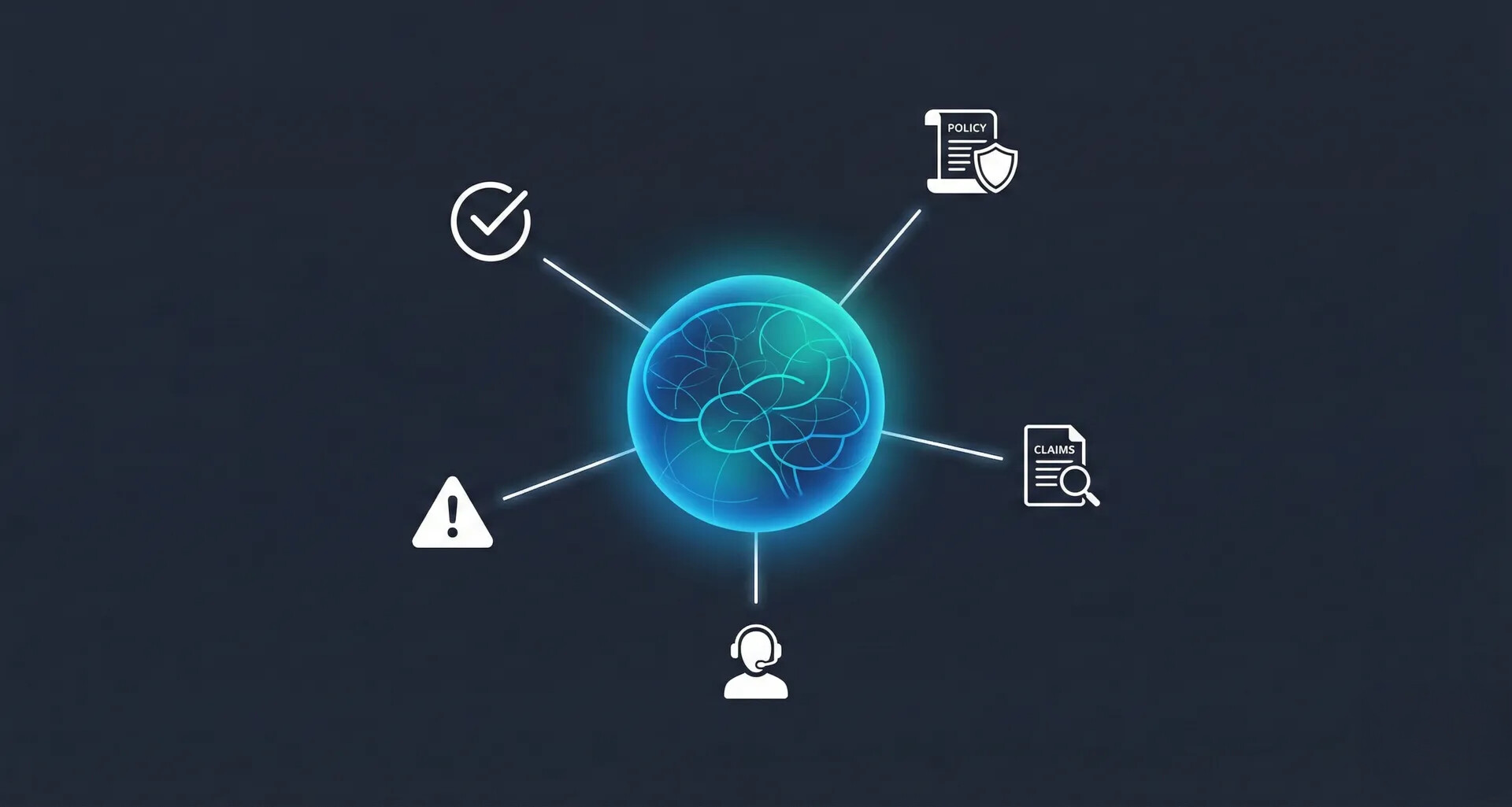
Your chatbot can tell a customer their claim status. But it can’t process the claim, detect the fraud pattern, or escalate the edge case to the right adjuster with full context. That’s not a feature gap. It’s an architectural limitation.
Insurance executives have spent the past five years investing in conversational AI, building chatbots that answer FAQs, route calls, and provide policy information. These tools delivered incremental value. They reduced call center volume and improved response times for simple inquiries. But they’ve reached their ceiling.
The next wave of agentic AI in insurance isn’t about better conversations. It’s about AI systems that can own workflows end-to-end: processing claims, detecting anomalies, orchestrating approvals, and knowing when to bring humans into the loop. The technology exists. The business case is clear. Yet most insurers find themselves stuck between successful pilots and production deployment.
This article examines why that gap exists and how to close it. We’ll explore the specific failure modes that trap AI projects in pilot purgatory, the architectural decisions that separate demos from deployment, and the practical path forward for insurance leaders ready to move beyond experimentation.
The chatbot ceiling: why basic AI falls short
Insurance chatbots were built for a specific purpose: handling high-volume, low-complexity inquiries. They excel at telling customers when their next payment is due, confirming coverage details, or routing calls to the right department. For these tasks, they’ve delivered real value.
But the limitations become apparent the moment a customer needs something done, not just answered.
Consider the difference between a chatbot and an AI agent handling the same scenario. A customer reports a fender bender. The chatbot can acknowledge the report and provide a claim number. It might answer questions about next steps or coverage limits. When the customer asks about the timeline, the chatbot retrieves standard processing estimates. The interaction ends there.
An AI agent approaches the same scenario differently. It captures the incident details, pulls the customer’s policy to verify coverage, initiates the claims workflow, identifies that the damage estimate falls within auto-approval thresholds, and routes the claim accordingly. If the photos suggest potential fraud indicators or the damage exceeds certain limits, the agent escalates to a human adjuster with full context. The customer receives updates as the claim progresses, initiated by the agent rather than requested by the customer.
The distinction isn’t just capability; it’s architecture. Chatbots are reactive systems that wait for input and provide responses. AI agents are proactive systems that initiate actions, make bounded decisions, and orchestrate multi-step workflows. Chatbots integrate with systems to retrieve information. AI agents integrate to both read and write, triggering downstream processes and updating records.
This architectural difference explains why upgrading a chatbot into an agent isn’t a software update. It requires rethinking how AI connects to your core systems, what decisions it can make autonomously, and how humans remain in control of outcomes that matter.
The production gap
If AI agents represent such a clear evolution, why aren’t more insurers running them in production?
The answer lies in a pattern that’s become endemic to enterprise AI: pilot purgatory. Organizations demonstrate impressive capabilities in controlled environments, declare success, and then struggle to operationalize what they’ve built.
The data tells the story. According to Deloitte’s State of Generative AI in the Enterprise report from Q4 2024, 65% of enterprises are experimenting with AI agents, but only 11% have deployed them in production. That’s a 54-percentage-point gap between experimentation and operationalization. Gartner’s 2024 AI Survey found that only 33% of AI projects reach production, meaning two-thirds fail to make the transition. Looking ahead, Gartner predicts that more than 40% of AI projects will be canceled by 2027 due to unclear ROI.
These aren’t technology failures. The AI works in the demo. The models perform well on test data. The use case makes business sense. The failure happens in the transition from controlled experiment to production system.
The insurance industry faces this challenge acutely. Carriers operate complex technology ecosystems built over decades, with core systems that weren’t designed for real-time AI integration. They’re subject to regulatory requirements that demand explainability and audit trails. Their data is fragmented across policy administration, claims, billing, and customer service systems. And they operate in a talent market where people who understand both AI architecture and insurance operations are exceptionally rare.
Understanding why pilots succeed but production fails is the first step toward closing the gap.
Why pilots succeed but production fails
The gap between pilot and production isn’t about AI capability. It’s about everything surrounding the AI: the architecture that supports it, the governance that constrains it, the systems it must integrate with, and the data it must operate on. Each of these dimensions presents failure modes that are easy to ignore in a controlled demo but impossible to avoid in production.
Designed for demos, not deployment
Pilots are built to impress. They showcase the 70% of cases that work perfectly, using clean data, controlled inputs, and scenarios selected to highlight capability. The edge cases, the exceptions, the messy reality of production data: these are explicitly excluded or handled through manual intervention that goes unmentioned in the demo.
Consider a claims intake pilot. The demonstration uses typed forms with complete information, clear photos, and straightforward coverage scenarios. It works beautifully. Production reality includes handwritten submissions, blurry photos, voice memos from distressed customers, incomplete information, coverage disputes, and claims that span multiple policies. The pilot architecture wasn’t designed for this complexity, and retrofitting it requires rebuilding rather than patching.
The happy path trap is insidious because the demo generates enthusiasm. Stakeholders see the potential. Budgets get approved. Only when the team attempts production deployment do they discover that handling the remaining 30% of cases requires more architecture than the original 70%.
Governance as afterthought
Pilots routinely skip explainability because the team plans to add it later. They defer bias monitoring because the immediate goal is proving capability. They don’t build comprehensive audit trails because regulatory scrutiny isn’t the point of a demo.
Production reality is different. Regulators require insurers to explain automated decisions. The EU AI Act classifies insurance AI as high-risk, requiring conformity assessments, documentation, and ongoing monitoring. State insurance commissioners ask questions about how algorithms affect pricing and claims decisions. When a customer disputes an AI-driven decision, someone needs to explain what happened and why.
The retrofit problem is severe. Adding governance to an ungoverned system isn’t a configuration change. It requires instrumenting every decision point, building explanation generation capabilities, implementing statistical monitoring for bias detection, and creating immutable audit logs with appropriate retention policies. Organizations that skipped these requirements in the pilot phase often discover that meeting them requires a complete architecture redesign.
Legacy integration complexity
Insurance runs on systems that weren’t designed for real-time AI integration. Policy administration systems like Guidewire PolicyCenter, Duck Creek, or Majesco operate with data models developed over decades. Claims systems maintain their own records. Billing operates independently. Customer data exists in multiple systems of record, often with conflicts. Many carriers still run COBOL systems for core functions.
Pilots avoid this complexity by using mock data, connecting to a single system, or building read-only integrations that pull information but don’t trigger workflows. Production AI agents need bidirectional integration: reading policy data, writing claim records, triggering approval workflows, updating customer communications, and maintaining consistency across systems that weren’t designed to share data in real-time.
The integration challenge compounds with each system added. Connecting to Guidewire Cloud through its REST APIs is different from integrating with an on-premise installation through the Integration Gateway. Legacy systems may lack APIs entirely, requiring wrapper layers that translate modern requests into formats the system understands. Batch processing cycles mean that data updated in one system may take hours to reflect in another.
Organizations consistently underestimate integration effort because the pilot didn’t require it. The demonstration connected to one system with read-only access. Production deployment requires connecting to five or ten systems with bidirectional data flow, all while maintaining audit trails and handling the inevitable synchronization conflicts.
Data quality assumptions
Pilots use curated datasets. Someone cleaned the data, resolved inconsistencies, and selected records that represent ideal scenarios. Production uses whatever data exists, with all its quality issues intact.
Insurance data presents particular challenges. Policy information fragments across systems, with billing holding payment history, policy administration holding coverage details, and claims holding loss history. Historical claims data often includes inconsistent categorization, as coding practices evolved over years or decades. Customer records contain duplicates, outdated contact information, and artifacts from mergers and acquisitions. Document stores hold unstructured PDFs, scanned images, and handwritten notes that no system has ever digitized.
AI agents amplify data quality issues. A human adjuster reviewing a claim can recognize when data looks wrong and investigate. An AI agent processing hundreds of claims per hour will confidently make decisions based on whatever data it receives. Bad data processed at scale creates bad outcomes at scale.
The data readiness challenge isn’t binary. Organizations don’t need perfect data to deploy AI, but they do need to understand which data is reliable, which requires validation, and which use cases demand data remediation before AI can operate effectively.
The talent gap isn’t what you think
The standard narrative about AI talent focuses on hiring difficulty: organizations can’t find enough AI engineers or data scientists. While this is true, it misses the more fundamental challenge.
Building AI that works for insurance requires people who understand both AI architecture and insurance operations. The AI engineer who built recommendation systems for e-commerce doesn’t inherently understand claims adjudication workflows, policy coverage logic, or regulatory compliance requirements. The insurance operations expert who knows every edge case in the claims process doesn’t inherently understand model training, inference optimization, or integration architecture.
Most AI vendors know AI but not insurance. They build capable systems that don’t account for industry-specific requirements. Most insurance IT teams know their systems but not AI. They can integrate software but struggle to architect AI solutions that actually work.
This expertise gap explains why partnership models matter. Organizations need access to people who combine deep AI capability with genuine insurance domain knowledge. That combination is rare, and building it internally takes years.
The window is closing
The industry isn’t standing still while organizations figure out production deployment. In January 2026, Allianz announced a partnership with Anthropic to deploy AI agents across their European operations. Major carriers are moving beyond experimentation toward committed implementation.
First-mover advantage in customer experience is real. Insurers who deploy production AI agents will process claims faster, respond to customers more quickly, and operate more efficiently. Their competitors, still stuck in pilot purgatory, will find themselves explaining why their service levels lag.
The window for competitive advantage is open, but it won’t stay open indefinitely.
Agentic AI architecture for production
Closing the pilot-to-production gap requires building for production from day one. This isn’t about adding capabilities later; it’s about architectural decisions made at the start that determine whether deployment is possible. Four pillars consistently separate organizations that reach production from those that don’t.
Governance-first design
Production AI in insurance requires comprehensive governance, not as a compliance checkbox but as a core architectural component. This means decision logging where every AI decision is recorded with input data, model version, confidence score, reasoning chain, timestamp, and outcome. It means an explainability layer that can generate natural language explanations for any decision, because regulators and customers will ask. It means bias monitoring pipelines that statistically track decisions across demographic segments and alert when patterns drift. It means model versioning with full rollback capability and A/B testing infrastructure for updates. And it means audit trails that are immutable, with retention policies aligned to insurance record requirements, typically seven years or more.
Building governance into the architecture from the start adds 20-30% to initial development cost. This investment prevents the far more expensive scenario of rebuilding an ungoverned system for compliance after the fact. Organizations that treat governance as something to add later rarely add it at all; instead, they find their pilot permanently stuck in pilot status.
Human-in-the-loop architecture
Human-in-the-loop isn’t a safety net for bad AI. It’s an architectural pattern that makes AI better over time while maintaining appropriate human oversight for consequential decisions.
Effective implementation starts with confidence thresholds that define boundaries for autonomous action versus human review. A claim under $5,000 with greater than 95% model confidence might auto-process. A claim over $50,000 or with less than 80% confidence triggers mandatory human review. These thresholds are configurable and should evolve as the system proves itself.
Escalation routing directs cases to appropriate human expertise rather than a generic queue. Fraud signals route to the Special Investigations Unit. Coverage disputes go to senior adjusters. Customer complaints reach retention specialists. The AI doesn’t just flag items for review; it provides full context about why escalation occurred and what the system’s preliminary assessment suggests.
Feedback loops ensure that human corrections improve future AI performance. When an adjuster overrides an AI decision, that correction feeds back into training. Override patterns reveal systematic issues that require model adjustment. The system learns from human expertise rather than repeatedly making the same mistakes.
This architecture requires instrumentation to track when and why humans override decisions, both for model improvement and compliance documentation.
Integration architecture for insurance systems
Connecting AI agents to insurance core systems requires patterns specific to the industry’s technology landscape.
For Guidewire environments, the approach depends on deployment model. Guidewire Cloud customers have access to REST APIs and webhooks for event-driven triggers. On-premise installations use the Integration Gateway with message queuing and batch synchronization. The Data Platform provides a real-time analytics layer that AI can consume without directly querying operational systems.
For legacy systems without modern APIs, organizations build API wrapper layers that present modern interfaces without replacing underlying systems. Event sourcing captures state changes as events for AI consumption without direct system coupling. Data lake approaches replicate relevant data to AI-accessible storage, accepting eventual consistency as a trade-off for decoupled architecture.
Anthropic’s Model Context Protocol (MCP) provides an emerging standard for secure AI-to-system communication. MCP enables AI agents to access tools and data sources with proper authentication and audit trails. For insurance, this is relevant for document retrieval, policy lookup, and claims history access, providing standardized, auditable system access rather than custom integrations for each data source.
Integration architecture must account for data consistency across systems that weren’t designed to share information in real time. This means understanding which system is authoritative for which data, how conflicts are resolved, and what latency is acceptable for different use cases.
Deployment flexibility
Production deployment must match organizational requirements for data residency, security, and operational control.
Cloud-native deployment offers the fastest path to production with the lowest operational burden. It’s suitable for workloads where data can reside in cloud environments and where the organization is comfortable with vendor infrastructure. For many insurers, non-sensitive workloads like customer communication or FAQ handling fit this model.
Hybrid deployment keeps AI processing in the cloud while data remains on-premise. This model addresses regulatory requirements around data residency while still benefiting from cloud scalability. Data flows to the cloud for processing, but persistent storage stays within the organization’s control.
On-premise deployment provides full data sovereignty. Some insurers, particularly those in heavily regulated markets or with specific security requirements, require this model. The operational burden is higher, but the control is complete.
The deployment decision isn’t purely technical. It involves data residency requirements set by regulation or policy, latency requirements for real-time use cases, existing infrastructure investments, and organizational security posture. Production architecture should accommodate flexibility, allowing different workloads to deploy in different models based on their specific requirements.
Addressing the real objections
Technical leaders evaluating AI agents raise legitimate concerns. Addressing these objections honestly, rather than dismissing them, builds the foundation for successful implementation.
Our data isn’t ready for AI
This objection is common, and it’s partially valid. Data quality issues are real, and they matter. But data readiness is a spectrum, not a binary state.
Start with the most structured data. Policy administration data is typically cleaner than unstructured claims notes. Billing records have enforced consistency that free-text fields lack. Identifying which data meets quality standards and which requires remediation lets organizations move forward with appropriate use cases while improving data quality in parallel.
Implement data quality scoring so the system knows which records are AI-ready versus which need human handling. Build feedback loops where AI flags data quality issues, humans correct them, and the corrections improve the underlying data. Accept that some use cases require data remediation first, but recognize that this doesn’t block all use cases.
Policy servicing use cases, including renewals and endorsements, typically have cleaner data profiles than complex claims adjudication. Starting there builds capability while data quality improves across the organization.
We’ve tried AI before and it didn’t scale
This objection deserves a specific question: what exactly didn’t scale? The answer reveals whether the issue was AI or architecture.
Performance degradation with volume indicates architecture that wasn’t designed for load. The solution involves horizontal scaling, caching, and async processing, not different AI. Accuracy drops in production suggest training data that didn’t match production data distribution. The solution involves continuous monitoring and retraining pipelines. Integration failures point to point-to-point connections that don’t scale. The solution involves integration architecture with API gateways and event buses. Regulatory challenges around decision explanation indicate missing governance. The solution involves governance-first design.
The pattern across most “failed AI” implementations is failed architecture, not failed AI. The models work; the surrounding systems don’t. Understanding what specifically failed guides what to do differently.
The technology is changing too fast to commit
This objection feels reasonable given the pace of AI development, but it’s actually an argument for moving forward rather than waiting.
Foundation models from Anthropic, OpenAI, and Google have stabilized enough for production use. The capabilities that matter for insurance automation, including language understanding, document processing, and decision support, are mature. Waiting for the next breakthrough means waiting indefinitely, because there will always be a next breakthrough on the horizon.
More importantly, model-agnostic architecture separates business logic from model implementation. Organizations can swap models without rebuilding their systems. The commitment is to architecture patterns, not to specific models that may evolve.
While organizations wait, competitors build data moats. Every claim processed through production AI becomes training data that improves the system. First movers accumulate advantages that late entrants can’t easily replicate.
We can’t find the talent
The talent gap is real but often misunderstood. Organizations don’t need AI researchers; they need AI engineers who can integrate with insurance systems. This is a narrower requirement than “AI talent” broadly.
The build versus buy versus partner decision framework clarifies options. Building internally makes sense if AI is a core strategic differentiator and the organization can attract and retain specialized talent, a rare combination. Buying packaged solutions works for commodity use cases like document OCR or basic chatbots. Partnering makes sense when use cases require domain expertise combined with technical depth, and when speed matters.
Internal capability building should focus initially on AI operations: monitoring, feedback, governance, and integration rather than AI development. This builds organizational muscle for managing AI systems while partners handle the specialized development work.
The path forward
Moving from pilot purgatory to production deployment requires clear prioritization. Not all use cases are equally suited for initial deployment.
High-priority use cases share common characteristics: high transaction volume creating clear automation value, relatively structured data with known quality levels, rules-based decisions with well-defined exceptions, and direct business impact on cost reduction or revenue protection.
Recommended starting points for most insurers begin with policy servicing for endorsements and renewals, where data is structured, volume is high, rules are clear, and impact is measurable. Quote generation offers customer-facing impact with relatively clean data and clear success metrics. Claims intake for first notice of loss handles high volume with structured initial capture and clear handoff points to human adjusters. Fraud detection as augmentation positions AI as human assistance rather than replacement, reducing risk while delivering high value.
Conversely, some use cases should wait. Complex claims adjudication requires too much judgment for initial deployment. Underwriting decisions face regulatory complexity and high stakes that demand proven capability first. Customer retention requires deep personalization and cross-system data that most organizations haven’t unified.
The sequencing matters. Early wins with appropriate use cases build organizational confidence, generate training data, and develop internal capability. Attempting complex use cases first risks failure that undermines support for the entire program.
Moving beyond pilot purgatory
The gap between AI experimentation and production deployment is the defining challenge for insurance technology leaders today. The technology works. The business cases are clear. What separates successful organizations from those stuck in perpetual piloting is architecture: governance built in from the start, human-in-the-loop patterns that improve over time, integration approaches suited to insurance’s complex technology landscape, and deployment flexibility that matches regulatory and operational requirements.
The competitive window is open. Major carriers like Allianz are making committed moves toward production AI. Organizations still experimenting will find themselves explaining to boards and customers why their competitors operate faster, respond more quickly, and process more efficiently.
The path forward isn’t about finding better AI. It’s about building the architecture that lets AI work in production.
If you’re ready to move beyond pilot purgatory, let’s talk. Our team has built production AI for insurance, and we can show you what’s possible for your organization.