
An AI agent that takes work off your team still needs a person. The question is where. Put them on every case and you've rebuilt the old process with an extra step. Put them on the cases the agent is unsure of, and on every step that can't be undone, and the rest runs without them.
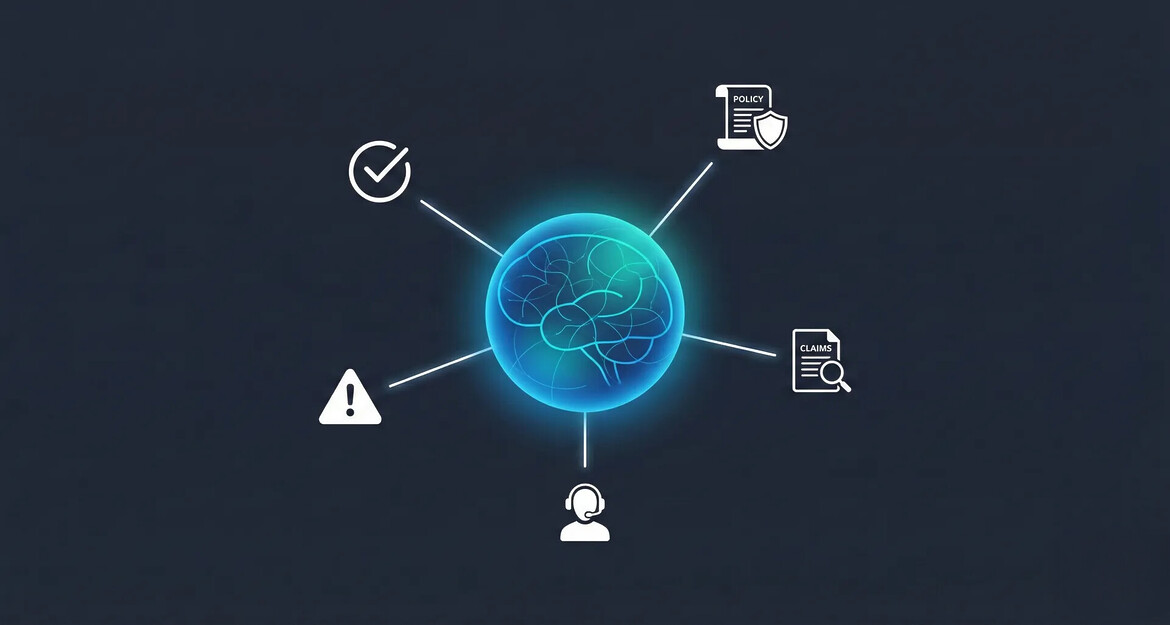
That's how we build agentic AI systems. In the agents we ship, every AI decision carries a confidence score, and the score decides the route. High confidence and low risk are approved automatically. Medium confidence goes to a review queue. Low confidence and high risk are escalated. The person decides the uncertain cases and sees the exact text before anything leaves the system.
What human in the loop means for an AI agent in production
Human in the loop means a person can step into the system's decisions. For an agent in production, the useful question is which decisions.
Human in the loop, human on the loop, human out of the loop
The EU High-Level Expert Group on AI describes 3 approaches to human oversight. They are human-in-the-loop, human-on-the-loop, and human-in-command. In its words, human in the loop is "the capability for human intervention in every decision cycle of the system, which in many cases is neither possible nor desirable." Human on the loop means a person can intervene during the design cycle and monitors the system while it runs. Human in command means overseeing the system as a whole and deciding when and how to use it, including overriding its decisions.
NIST's AI Risk Management Framework says human-AI configurations "can span from fully autonomous to fully manual." Human out of the loop is the fully autonomous end.
Put the person where the uncertainty is, not on every case
A person on every case becomes the bottleneck. Too little oversight is the opposite mistake: the less oversight a person can exercise, the guidance says, the more testing and the stricter governance the system needs.
So the design question is placement. In our work, "what is uncertain goes to a person" is a routing rule. A case the agent is unsure of goes on hold: it waits in an inbox until a person releases it. We add no holds nobody asked for. Documents and rules are the common case, not the limit: any process step where an agent can be unsure gets the same treatment.
The agent proposes and says where it's unsure
The agent does the work and marks what it isn't sure of. The person checks only those marks.
A confidence score on every document and every field
The expert group asks that when some inaccurate predictions can't be avoided, a system "can indicate how likely these errors are." On Reperks, text recognition runs with confidence scoring, even on handwritten notes and low-quality scans. Extractions below the threshold trigger a confirmation flow with the uncertain fields highlighted.
Classification first, then extraction with a template for each type
On Reperks, the document type is classified first (invoice, property manager summary, rental contract, meter reading). Then an extraction template for that type does the reading. In our intelligent document processing pipelines, high-confidence documents flow through automatically, and low-confidence ones are flagged for human review. For the document side in depth, read how intelligent document processing automates workflows on AWS.
Show what the agent read before the options it built on it
A confidence score can be wrong. A peer-reviewed study, Guo et al., "On Calibration of Modern Neural Networks" (ICML 2017), found that modern neural networks "are poorly calibrated," meaning their stated confidence doesn't match how often they're right. A 2026 arXiv preprint by Michael et al., not yet peer-reviewed, found that large language models are overconfident on average, most of all on difficult tests.
So the question a person sees starts with the input. When the Reperks agent can't match a letter to a tenant, it opens a pending case and asks instead of guessing. The question shows first what the agent read, then the possible tenants. The person checks the reading, not the list, because an early extraction error produces candidates that look as plausible as the correct ones.
Check the record before asking the person
Before asking the property manager, the Reperks agent looks for the answer in earlier years' statements. Only what no year answers stays provisional for the property manager to confirm.
Amounts, dates, and names come from text someone else controls. They reach a write only after deterministic validation, and an unknown sender or a field that won't parse goes to a person with nothing written.
Where the threshold sits, and which way to err
No single threshold fits every system. What sets it is which mistake you can take back.
A held case is visible, a wrong match is silent
On Reperks, a wrong match is worse than a hold. A hold is visible, while a wrong match lands silently in the tenant's statement. Erring toward the hold costs a few more held cases. Cases the system can't resolve at all stop visibly too, with an error or a question to a person.
Choose the error you can take back
An error the next run corrects is cheap even when it's frequent. One with no way back is expensive even when it's rare. Microsoft's AI Red Team gives the same advice: scale approvals with how reversible an action is and its blast radius.
A refused hard case is the system working
On a real portfolio import, the Reperks agent refused to route contracts with blacked-out passages automatically and sent them to manual review. The team kept that behavior instead of relaxing it to get the data set through.
The share of cases that reach a person is a number you measure
When we measure an automation, we take time per unit of work before and after, plus the share of cases that still reach a person. You see what the system handles and what it leaves to your team.
Case study: See how the Reperks agent scores what it reads and asks the landlord to confirm
The person decides, and sees the exact text first
The person makes the call on what will actually happen.
Draft first, send on approval
An agent that writes on someone's behalf drafts first, shows the full text with its recipients, and sends only on explicit approval. Before any external step that can't be undone, the person approves the exact text that will leave. On Reperks, the landlord sees and approves everything before it goes to tenants. In a pilot, real writes into your systems start in weeks 2 to 5, after your process owner has validated the drafts.
Text the system prints for others gets signed off against its source
On Reperks, any new sentence the system prints on a tenant-facing statement is approved by a person in both German and English, checked against the actual contract clause. One such review changed a legal term and added a missing sentence.
The model names the change, code counts what it touches
For a change across many Reperks buildings, the model only names the buildings, the selection and the change. Code counts the buildings and units and lists the values that would be overwritten, and the change opens only after the person has chosen an option.
We record when a person set a value
On Reperks, a value a person wrote carries a mark that says so. A value without that mark didn't come from a user. In the agents we build, every agent action is logged. The log holds the input, reasoning chain, tools called, validation results, confidence score, routing decision, and outcome.
Test that the approval step can't be bypassed
The approval step is an attack surface. Microsoft's AI Red Team, reporting on 12 months of engagements against deployed agentic systems, found human-in-the-loop bypass "the most consistently exploited failure mode, at very high frequency." Red teamers got through with consent fatigue, manipulation of probabilistic invocation, and escalation chains where no single step warranted review but the combined outcome did.
Microsoft also recommends breaking compound actions into their steps, summarizing approval prompts from the underlying tool calls rather than from the agent's own description, and monitoring approval frequency.
Where we've built it
Here is where this runs in production.
Reperks: confidence scores on landlords' documents
German landlords must prepare a utility cost statement for each tenant every year. We built the AI agent behind Reperks to prepare it, and the work went from 20+ hours to 10-15 minutes. We see the same gains in our own work and in client work beyond Reperks. Full automation would have failed, given how much document quality varies, so we designed explicit confirmation flows instead.
Trusted Carrier: data verified once, used at 40,000+ documents a week
Trusted Carrier handles 40,000+ documents a week in 13 countries. We've built and maintained the system for over 10 years. Transport partners enter vehicle data once. It's centrally verified to chemical industry standards, then available as validated data across all participating facilities. The system classifies the documents it receives, gives each one a confidence score, and sends the uncertain cases to a person. See how the Trusted Carrier ecosystem works
Before a system takes over a calculation
We hand a calculation to a system only once it passes an acceptance test. The system has to reproduce the figures your people checked by hand, first on past periods, with test sets built with your domain expert.
Human oversight under the EU AI Act
The EU AI Act turns human oversight into a design requirement for high-risk systems. Here is what the text asks, in plain terms. For legal advice, ask a lawyer.
What Article 14 asks of high-risk systems
Article 14(1) requires high-risk AI systems to be designed so that people can effectively oversee them while they are in use.
Under Article 14(4), the system must enable the people assigned to oversight, "as appropriate and proportionate," to do the following. They stay aware of automation bias, which the Act describes as "the possible tendency of automatically relying or over-relying on the output." They can decide not to use the system in a particular situation, or disregard, override, or reverse its output. They can interrupt it through "a ‘stop’ button or a similar procedure that allows the system to come to a halt in a safe state." Under Article 26(2), the organization using the system assigns that oversight to people with the necessary competence, training, and authority, and the necessary support.
Logs that show what the system did
Article 12(1) requires that high-risk systems "technically allow for the automatic recording of events (logs) over the lifetime of the system." Under Article 26(6), the organization using the system keeps the logs under its control for a period that fits the system's intended purpose, at least 6 months, unless other Union or national law provides otherwise.
When the rules apply
Article 113, as amended by the Digital Omnibus on AI, sets the dates for the high-risk requirements. They apply from 2 December 2027 for systems classified high-risk under Article 6(2) and Annex III, and from 2 August 2028 for those under Article 6(1) and Annex I. Our agents ship with risk classification, transparency documentation, and human oversight.
See how much work a pilot takes off your team
6 weeks, one process, your own data. We measure in week 1 and again in week 6, including the share of cases that still reach a person, and you decide what happens next.

Andrei, CTO and co-founder of HyperSense Software Inc., has an extensive career spanning over 15 years in the tech industry. With hands-on experience in mobile and web development, cloud infrastructure, and DevOps, he has been instrumental in both startup launches and enterprise-level tech transformations. His approach intertwines deep technical knowledge with strategic business insights, aiding in everything from vision setting and market research to contract negotiations and investor relations. As a member of the Forbes Business Council, he consistently delivers valuable insights in the areas of technology and people management.