Data warehouse technology turns the vast volumes of sales, customer behavior, and operations data that companies collect every day into actionable insight. Merely gathering data creates little value on its own; true competitiveness comes from how you structure, analyze, and act on that information.
By serving as a single, trusted source of truth, a well-built data warehouse unlocks faster reporting, sharper management, and lower costs for organizations of any size. In this article, you’ll learn exactly how a data warehouse can elevate your business.
Redefine Your Business with Digital Transformation
Innovative Digital Solutions, Designed for Your Unique Needs
Explore Digital TransformationWhat Is a Data Warehouse?
All the data from an organization is gathered in a data warehouse for use in analysis and reporting. Essentially, it consolidates data from multiple sources and compiles it into a single location. Amazon Web Services defines a data warehouse as a repository where data is stored for analysis, facilitating informed decision-making.
Specifically, information on sales, customers, and inventory is extracted from various programs, standardized, and stored in a warehouse. Likewise, IBM points out that a warehouse consolidates data from multiple sources into a single, common, and consistent store to facilitate analytics, business intelligence (BI), and machine learning.
A data warehouse is built for analysis purposes, and it holds cleaned and organized data, often stored in tables or schemas that contain records from both the past and the present. According to Google Cloud, warehouses can store all your data, both old and new, in one location and are designed to provide a comprehensive overview of your data trends.
Business leaders can utilize this time dimension to monitor trends and successes that emerge over several months or years. Simply put, a data warehouse enables business users to view all their data in one place, run queries, generate reports, and build dashboards from a single source.
Why Companies Use Data Warehouses?
To address the issue of scattered data and make informed decisions, businesses establish data warehouses. Growing amounts of data lead companies to store information in isolated systems, such as online sales platforms, marketing tools, and financial systems. Without integration, analysts must spend a considerable amount of time making different data systems work together.
The warehouse accomplishes this by collecting data in a single location. For instance, a warehouse is now a vital part of retail, as it collects all the data needed by managers. This means that all departments can utilize the same information, thanks to the warehouse.
In fact, data warehouses remove the need for manual tasks. Instead of running five different reports, employees can get what they need from the warehouse in a single query. Often, this kind of access to data is referred to as a “global view” of the company.
According to Fivetran, companies using warehouses benefit from seeing “all their data from various sources in just one simple place”. With access to their data, business analysts can complete ad hoc queries and obtain results immediately.
Having this speed matters a great deal when the market changes rapidly. As an example, a manager may ask for the best-selling items in each region today; the answer appears quickly with a warehouse and analytics tools.
Many organizations establish data warehouses to ensure their data is reliable and of high quality. If data is stored in multiple systems, it can lead to errors and inconsistencies. Bringing data together makes it easier to correct, standardize, and verify it.
As explained by one source, using a warehouse helps firms maintain accurate, up-to-date records, which in turn allows them to make decisions they can trust. In most cases, warehouses consolidate multiple versions and format the data consistently, ensuring that all users view the same clean data.
Additionally, utilizing modern cloud-based warehouses helps companies grow and reduce their expenses. On-site data storage can be both costly and inflexible, but cloud data warehouses (like Snowflake, BigQuery, and AWS Redshift) give you the ability to scale up or down easily.
Experience Expert IT Consultancy
Transformative Strategies for Your Technology Needs
Discover IT ConsultingBusinesses can adjust their storage and computing resources as needed. In other words, you won’t need to invest in more hardware when your data increases. Cloud warehouses are reportedly offered by one vendor on a pay-as-you-go basis, so businesses don’t need to pay for hardware upfront. Because maintenance can now be outsourced and costs are lower, data warehousing is an option for businesses of all sizes.
Companies can utilize AWS Redshift, Azure Synapse, or Google BigQuery in the cloud to scale their resources as needed, a tactic discussed in Lean AWS Cost Optimization, which guides startups and CTOs on how to optimize infrastructure costs.
Key Business Benefits of a Data Warehouse
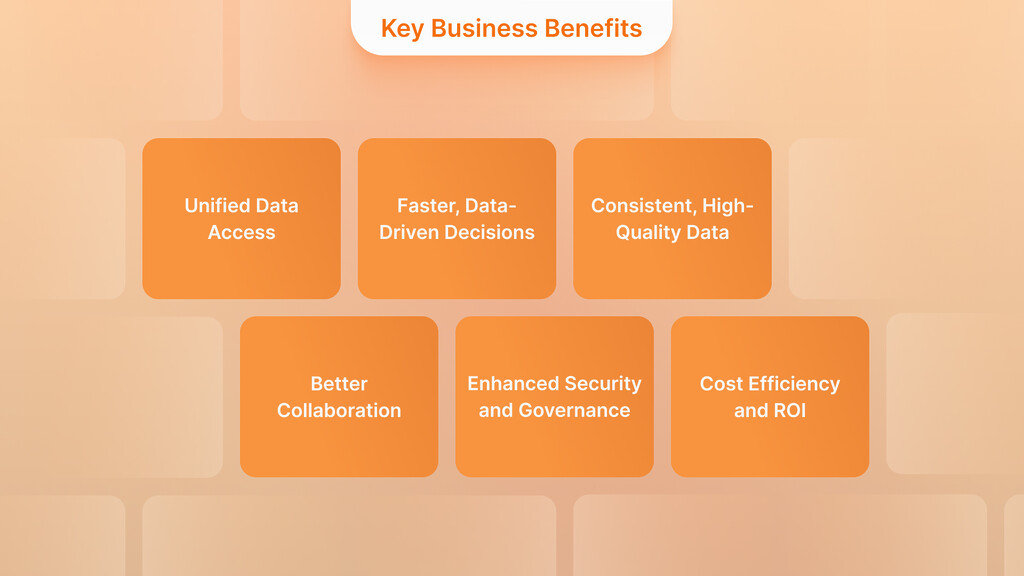
Data warehouses offer numerous distinct advantages that enhance a company’s finances and facilitate informed decision-making.
Unified Data Access
Integrating all business data into a single location enables leaders to view the entire picture at any time. There is no need for analysts to merge reports manually anymore. So, they just query the warehouse since they trust the data will be unchanged. It allows different departments to report their data in a unified manner.
Faster, Data-Driven Decisions
The pre-integrated data in the warehouse lets companies quickly answer their questions. Executives and analysts are no longer required to spend time preparing data before gaining insights. According to Fivetran, by making data simple to access and sort out, data warehouses speed up the process of making better decisions. As a result, tasks that would typically take days to complete, such as finalizing month-end sales or making forecasts, are now completed almost instantly. Businesses can respond to changes or issues more efficiently.
Consistent, High-Quality Data
Warehouses ensure that data is accurate and reliable. At the loading stage (ETL/ELT), any data challenges are addressed, ensuring that reports contain only accurate numbers. For instance, customer records from various systems can be consolidated into a single location, and different formats can be standardized. All the reports and analyses depend on data that has been validated through central data quality processes. It was explained earlier that accurate and up-to-date data produces more precise and specific insights and decisions.
Better Collaboration
When every team uses the same warehouse, they can collaborate more effectively using the same dataset. The same figures can be used across marketing, sales, finance, and operations. Campaign results can be analyzed jointly by marketing, sales, and finance, allowing them to compare budgets to actual sales without discrepancies. In brief, using a shared warehouse helps eliminate confusion about the correct version of a report.
Experience Our Skilled Development Teams
Elevate Your Projects with Skilled Software Development Professionals
Get Your Development TeamEnhanced Security and Governance
Centralization of data increases data security. By using a managed platform, IT is no longer required to manage many independent systems. In general, warehouses implement strict access controls (ensuring only authorized personnel can access private data) and employ secure encryption. According to one expert, using just one network makes it simpler to preserve data. Additionally, many cloud warehouses offer compliance assistance, including audit logs and data masking, without requiring extra effort.
Cost Efficiency and ROI
Although creating a warehouse incurs costs, the return on investment is often worth the effort. By combining your data, you can save money on licensing and maintenance for various reporting tools. They help organizations analyze their data more efficiently and identify opportunities to save or generate money. A report found that over the past five years, modern cloud data warehouses have provided a 417% return on investment for companies utilizing them. Basically, the system’s benefits and discoveries make the expense worthwhile.
This means there is real value for organizations. Rapid analysis supports accurate sales predictions, more effective customer targeting, and enhanced business operations. The following section explains the differences between data warehouses and data lakes, helping you determine when to use each approach.
In the article Harnessing HPC and Cloud Pipelines to Tame the Genomic Data Deluge, the authors highlight how centralized data systems, similar to data warehouses, help manage massive datasets efficiently.
Data Warehouse vs. Data Lake
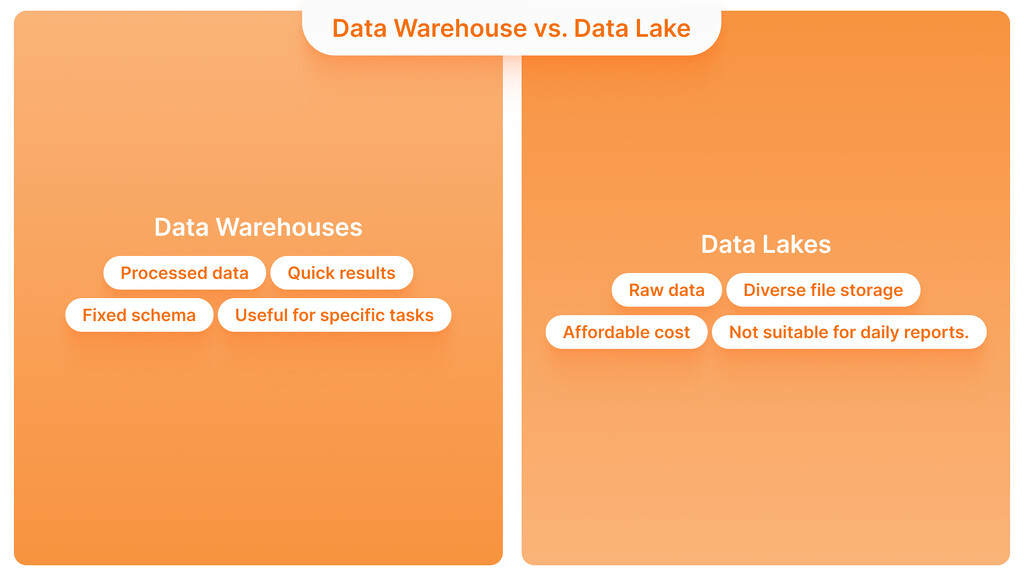
Although data warehouses are often mentioned in conjunction with data lakes, they serve different purposes. The kind of data and the applications they serve are essential differences. In general:
Data Warehouse
A data warehouse contains processed data that is easy to analyze for business purposes. All the data has been cleaned and placed into tables or schemas appropriate for analysis. Warehouses help achieve quick results when searching through lots of joined data. Examples of their work include determining the number of units sold last quarter in each region and calculating the average transaction size for each customer group over the past year. The fixed schema helps make queries simple and enables them to run efficiently. Splunk defines it simply: a warehouse holds a large amount of structured data that is organized and prepared for a specific task.
Data Lake
A data lake is where you keep all raw data with no structure or only a weak structure. Upfront, there is no set pattern for the content. A lake can store text files, images, logs, JSON records, videos, and virtually any type of data. Companies use data lakes to store vast amounts of data at an affordable cost or to carry out complex data science. Since the data is not prepared, it requires individuals with advanced data skills to utilize it effectively. One expert describes lakes as “enormous” and capable of storing “all kinds of unstructured information”. A data lake is well-suited for examining and training with large datasets, but it is less effective for day-to-day business reporting.
If you think of a warehouse as an organized library of books, the information is stored in a way that allows many people to access it quickly. A data lake functions like a large, unfinished storage area, storing all the raw information that requires processing before it is utilized. Often, companies store raw data in a data lake and then transfer the necessary, cleaned information into the warehouse for business analysts.
Illustrative Example: Retail Chain
Picture a company that runs hundreds of shops and continues to grow its online presence. We get sales every day from our stores, online site, and third-party sites. Additionally, the company monitors customer loyalty statistics and shipments throughout the supply chain.
Before using a data warehouse, analysts had to manually combine data from different sources to answer simple questions. Let’s say you wanted to forecast next month’s inventory; you’d have to manually add together last month’s sales, understand online trends, and check the delivery times of your suppliers, which takes time and often leads to mistakes.
When you have a data warehouse, all your important data ends up in one system. The warehouse receives new data daily from point-of-sale transactions, online orders, inventory levels, and customer information. Now, a store manager can easily review sales by category or see how popular products are online or in the store by using a few clicks.
If the team needs to determine which sales promotions were the most successful, they can refer to the warehouse data for answers. You don’t have to handle spreadsheets anymore. Now, answers to questions that once required a lot of manual data work are available almost instantly.
The result of this approach is better decision-making. When the company utilizes full data, it can predict demand more accurately. Rather than assuming, it can examine warehouse data to discover that jacket sales increased by 20% this January and adjust orders for the next winter season.
According to Alibaba Cloud, utilizing sales data from the warehouse enables retailers to “predict demand for each product” and optimize their stock levels. Using these forecasts, the supply-chain team in our retail example can send out more of the items that sell quickly and reduce the stock of those that do not, thereby saving money.
Also, managers receive important information more quickly. Should the CEO wish to know last quarter’s overall growth in a meeting, that information can be pulled from a dashboard in minutes, thanks to the warehouse. It would have taken a data engineer working manually several days to produce that number. Once more, the warehouse helps by making key information accessible so everyone who needs it can find it in one spot. Making decisions swiftly becomes easier since responses depend on accurate and up-to-date data.
As a result, uniting various data sources and providing fast query tools, the data warehouse turns operational data into useful business information. With reports, managers feel more confident, keep a closer eye on performance through dashboards, and make more informed decisions using facts instead of intuition. Over time, these capabilities lead to both increased profits and more efficient processes within the company.
Fueling Growth Through Data Warehouse
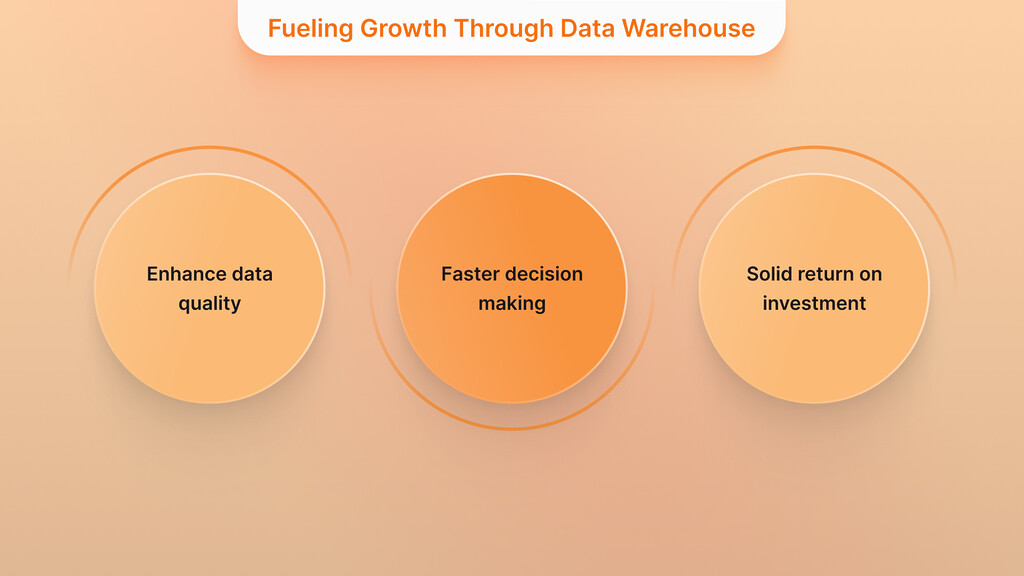
Overall, a data warehouse plays a key role in providing data tools for businesses focused on data. It consolidates data from the entire enterprise into a single location, ready for analysis. Organizations rely on data warehouses to consolidate their data, enhance data quality, and expedite the reporting process. Companies benefit from making decisions more quickly, enhancing their operational efficiency, fostering teamwork, and typically achieving a solid return on investment. Although data lakes and other systems are available for specific purposes, data warehouses remain the top choice for executives who require structured and reliable data. Any business leader seeking to leverage data should first understand and invest in a data warehouse to make more informed decisions.
Contact us to discover data warehouse and backend solutions tailored to your specific needs.
Making Product Discovery Clear and Accessible
Transform Concepts into Products in Four Weeks with Our Proven TechBoost Program
See Product Discovery ServicesKey Takeaways
- A data warehouse is a designated area that houses and organizes data for rapid analysis and reporting.
- It serves the needs of business intelligence by ensuring that accurate and consistent information is available from various sources.
- Benefits:
- Makes decisions easier to understand.
- Enhances the efficiency of the business and the accuracy of its information.
- Can adjust to support the growth of your business.
- Unlike data lakes, data warehouses hold processed data that is prepared for analysis.
- Many industries, including retail, finance, and healthcare, utilize data warehouses to stay ahead of the competition.
- Investing in a data warehouse gives your organization the advantage of handling the challenges of modern data-driven business, keeping you flexible, well-informed, and one step ahead. The article The Essential Guide to Custom Software Development presents the advantages of custom software.
What is a data warehouse and how does it work?
A data warehouse is a centralized repository that gathers, stores, and organizes structured data from sources such as sales, marketing, finance, and operations. It applies processes such as ETL (Extract, Transform, Load) or ELT, cleans the data, integrates it, and stores it. This is designed to simplify data access and analysis for business intelligence, reporting, and strategic decision-making. It enables users to query, create dashboards, and gain insights from a single, reliable source of truth.
What are the main benefits of using a data warehouse?
The main advantages of a data warehouse are improved decision-making, reduced time, and uniformity of data across departments. There is no longer a need to collect reports using multiple tools, and everyone is working with the same clean, accurate data. It can also enable near-real-time or real-time analytics, predictive modeling, and enhance operational efficiency. It delivers a quantifiable return on investment for many organizations by improving performance and reducing manual data entry.
What’s the difference between a data warehouse and a data lake?
Information in a data warehouse is stored as structured, cleaned data that can be reported on and analyzed. It is business-focused and supports quick SQL-based queries and dashboards. In contrast, a data lake stores raw, unstructured data such as images, logs, and JSON files. Data scientists and data engineers often use it for data exploration, machine learning, and AI. While a warehouse is akin to a well-organized library, a data lake is an extensive repository of unstructured data.
Why do businesses use data warehouses?
Data warehouses help businesses address the problem of data scattered across various platforms, such as CRM, ERP, eCommerce, and marketing tools. In the absence of a centralized system, teams will spend time manually consolidating data, resulting in inconsistent figures across teams. The answer is a data warehouse, which aggregates and standardizes data. This simplifies analytics, minimizes errors, accelerates reporting, and enables executives to make better, faster data-driven decisions.
Which data warehouse tools and platforms are most popular?
Amazon Redshift, Google BigQuery, Microsoft Azure Synapse Analytics, and Snowflake are among the most popular cloud data warehouse platforms on the market today. They offer automatic scaling, pay-as-you-go pricing, high-speed querying, and compatibility with tools such as Power BI, Tableau, and Looker. They are designed to handle high data volumes and are used across industries to deliver real-time analytics and business intelligence.
Is a data warehouse secure for storing business data?
Indeed, contemporary data warehouses are built with enterprise-grade security controls. They usually involve encryption at rest and transmission, role-based access control, audit logs, and compliance with state regulations, such as GDPR, HIPAA, and SOC 2. There is also cloud-based data masking, automatic backup, and multi-factor authentication. Centralizing data is, in fact, better for governance and easier to monitor and enforce policies.
Can small businesses benefit from using a data warehouse?
Absolutely. Large enterprises are not the only ones who can use cloud data warehouses. With scalable, cost-effective systems such as Redshift and BigQuery, SMBs can also enjoy easy access to centralized data. Such sites use dynamic pricing, so SMBs can pay when using them. It enables smaller teams to make informed decisions and monitor KPIs and performance trends without investing in expensive on-premises hardware.
How does a data warehouse improve data quality?
A data warehouse improves data quality by cleaning, transforming, and validating data before storage via ETL or ELT processes. This will ensure there are no duplicate records, inconsistent formats are normalized, and errors are identified early. By consolidating all information into a single source and enforcing strict governance rules, organizations can achieve high accuracy and consistency, leading to more credible reports and analyses.
How fast can a data warehouse deliver insights?
It is designed to query data quickly, enabling users to generate insights in minutes rather than hours or days, compared with data warehouses. Since the data is already cleaned and indexed, business users do not need IT assistance to run queries. This helps to present monthly reports faster, respond to market changes more quickly, and make decisions more agile. Dashboards can be updated in real time or near-real time using modern BI tools connected to the warehouse.
How does a data warehouse support business growth?
A data warehouse supports expansion by providing a single, clear view of operations, customers, and trends. It helps firms predict demand and identify inefficiencies, KPIs, and opportunities more quickly. This data-driven solution enables companies to expand innovatively, enhance the customer experience, and outperform competitors. A warehouse is the place to gain the knowledge to grow with confidence, whether it is optimizing inventory or a marketing strategy.
How do cloud data warehouses help cut costs?
Cloud data warehouses do not require physical servers, equipment upgrades, or large IT departments to operate. In pay-as-you-go models, businesses can scale storage and compute power up or down based on actual usage. They also reduce licensing costs by consolidating multiple reporting tools into a single centralized platform. In the long term, it will result in tremendous cost reductions and high return on investment- particularly when coupled with automation and self-service analytics.
What are real-world examples of data warehouse use?
The most common example is a retail business integrating physical store operations, virtual sales information, customer reward schemes, and supply chain indicators into a single warehouse. Their analysts had to spend days compiling reports manually before using a warehouse. With a warehouse, they can now access real-time dashboards on best-selling items, regional trends, and stock gaps to adjust campaigns, restock effectively, and make predictions. Such applications are found in healthcare, finance, manufacturing, and SaaS.